
CPWC Certification
The California workers’ comp adjuster training employers accept
The 120 classroom hours California requires of a new claims adjuster, on demand. No class dates, so a new hire can start the day they’re hired.
New to the field
What the job is, what it pays, and how to start a career in claims.
Training a team
Seats for your new hires, purchase orders, and records for your file.
Flexible financing available. Pay over time with ShopPay, starting at about $180/mo.
24 CPWC Modules
Covering statutory topics required by the state
Rating based on verified student surveys from CPWC program
Flexible Schedule
6 months at 5 hours a week
Learn at your own pace
12 months
The window California gives a new adjuster to finish the training
“IEA’s CPWC certification has been a great training solution for our new hires. Meeting the required 120 hours of instruction and statutory topics in an On-demand turn-key program has made my job so much easier.”
Dan Henley · EMPLOYERS® Insurance
Why California employers use CPWC
CPWC is California’s recognized training for workers’ comp claims professionals. It teaches the state’s specific rules, benefits, and procedures, exactly what employers need you to know, so you can step into an entry role prepared, with the knowledge California employers are looking for. No prior experience required.
Backed by 150 years of IEA training and trusted by California’s TPAs, insurers, and public agencies.
Why CPWC for California workers’ comp?
Real-world training for the people who power workers’ compensation.
For employers, HR leaders, and risk managers, CPWC delivers standardized, regulator-aligned training that reduces liability and builds internal expertise. A smart investment in accuracy, efficiency, and claims outcomes.
I work in comp and need a path to become an adjuster.
Many professionals want to grow into adjuster roles but lack formal training. CPWC bridges the gap between support roles and adjusting, meeting CCR 2592.02 standards and giving you the knowledge and confidence to move up.
I don’t know where to start.
CPWC gives you a clear foundation, fast. Whether you’re new to the industry or changing careers, you’ll learn how claims work from start to finish, with real-world scenarios, legal context, and step-by-step guidance.
How it works
From choosing your track to stepping into a role, here is the path.
1
Choose your track
Pick the CPWC path that fits the role you want, no prerequisites.
2
Train online, self-paced
Work through the material on your own schedule, around a job or other commitments.
3
Get certified
Earn your CPWC certification in California workers’ compensation.
4
Step into a role
Enter an entry role prepared, then grow into full adjusting and beyond.
“Your training gave me the vocabulary and concepts to understand the why behind the claims work we do each day. An accessible entry point into a complex field.”
Jerold Johnson, CPWC — Workers’ Comp Claims Adjuster, Sedgwick
Choose your path to certification
Most people earn a full CPWC certification. You can also take modules one at a time.
CPWC-MBR
The most affordable way in. Review and validate medical billing on claims.
$1,079
or about $180/mo
$1,899
or about $316/mo
$2,499
or about $416/mo
Not sure which track fits you? Compare MBR, MO, and Indemnity in detail
Not ready for full certification? Take individual modules at $119 each.
Buying for a hiring class?
Most CPWC seats are bought by a claims supervisor for new hires. Buy seats against your hiring plan and assign them as people start.
- Volume pricing from two seats. 5% off at 2 to 5, 10% at 6 to 10, 15% at 11 or more.
- Purchase order and NET 30. Pay by ACH or check. One invoice for the team.
- Records for your file. Certificates and completion records for every learner.
- A named account manager. Malaysia handles your account and replies within one business day.
Handling California claims from outside California?
You don’t need to be in California to train here. If your adjusters handle California claims, CPWC is the California-specific curriculum, on demand, with no California training department needed.
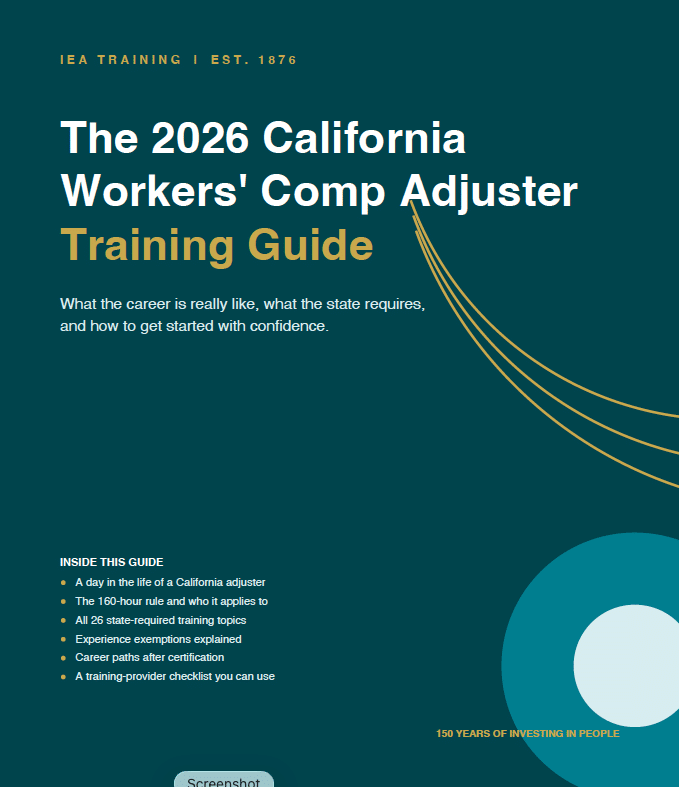
Not ready to decide? Take the guide with you.
What the career is really like, what California requires, and how to choose the right training. Sent straight to your inbox.
Free instant delivery • no spam
California workers' compensation adjuster training hours
Minimum training required under CCR Title 10, Section 2592
Remaining hours are completed as employer-provided on-the-job training.
“This program provided an excellent, practical deep dive into California workers’ compensation rules and procedures. The detailed insights on claims handling, dispute resolution, and statutory compliance have significantly boosted my confidence and effectiveness on the job. Highly recommended!”
Ashleigh Morgan, CPWC · Sedgwick
The experts behind the CPWC curriculum
CPWC is built on Sullivan on Comp — a 16-chapter analysis of California workers’ compensation law, updated monthly. The attorney who co-writes it reviews and revises this course.

Karen Heffernan
Former Vice President of Training, Sedgwick
Rebuilt the CPWC curriculum in 2024.

Sure Log, Esq.
Of Counsel, Michael Sullivan & Associates
Co-author of Sullivan on Comp. Reviewed and revised CPWC’s content and exams for regulatory compliance in 2026.
Individual CPWC Modules
Learn one topic at a time, pay as you go
“The most helpful part of the course was how it explained the workers’ compensation settlement process in a clear and practical way. The sections covering Compromise and Release (C&R) settlements, Medicare Set-Asides (MSAs), and the role of the claims adjuster were particularly valuable because they showed how legal requirements and claim management decisions work together in real cases.”
Hasanat Khan, CPWC
“As a business owner, this course has been a valuable resource. It’s given me a clearer understanding of the workers’ compensation process and what’s at stake when claims arise.”
Jose Mejia, CPWC
Explore the historical foundations and evolution of California’s workers’ compensation system. Understand the purpose, key principles, and legal framework that shape claims handling today.
$119
Learn the fundamentals of workers' compensation coverage, financing, and policy structures. Discover how claims are administered, including employer responsibilities and third-party administrators.
$119
Master the first steps of a workers’ compensation claim. Gain hands-on knowledge in gathering critical documentation, establishing compensability, and setting up claims for success.
$119
Delve into the legal doctrine of exclusive remedy and its exceptions. Explore different types of workplace injuries and alternative liability theories that may impact claims.
$119
Understand the key elements that determine if an injury is compensable under California law. Learn about AOE/COE (Arising Out of and In the Course of Employment) and legal causation.
$119
Explore statutory defenses and exceptions to compensability. Analyze legal exclusions such as intoxication, self-inflicted injuries, horseplay, and post-termination claims.
$119
Get a complete breakdown of the benefits available to injured workers, including medical treatment, temporary and permanent disability, death benefits, and supplemental job displacement.
$119
Navigate complex medical terminology used in workers' compensation. Learn about common diagnostic procedures, impairment assessments, and how medical evidence influences claims.
$119
Understand the processes for authorizing and disputing medical treatment. Learn about the Medical Treatment Utilization Schedule (MTUS), utilization review (UR), and independent medical review (IMR).
$119
Explore the role of Qualified Medical Evaluators (QMEs) and Agreed Medical Evaluators (AMEs). Gain expertise in resolving medical-legal disputes through proper reporting and procedural compliance.
$119
Master California’s workers’ compensation fee schedules, medical billing codes, and reimbursement guidelines. Learn how to analyze bills and avoid overpayment pitfalls.
$119
Gain practical skills in managing liens, including medical provider liens, interpreter fees, and copy service disputes. Learn negotiation strategies to minimize claim costs.
$119
Understand ethical obligations in claims handling. Learn about conflicts of interest, confidentiality, and best practices for maintaining integrity in workers' compensation administration.
$119
Prepare for claim audits by mastering the regulatory framework enforced by the Division of Workers’ Compensation (DWC). Learn how to ensure compliance and avoid penalties.
$119
Detect and prevent fraud at every level of a workers’ compensation claim. Learn investigative techniques for employer, employee, and provider fraud cases.
$119
Understand the role and jurisdiction of the Workers’ Compensation Appeals Board (WCAB). Learn about the dispute resolution process, trial procedures, and appeals.
$119
Calculate workers’ compensation benefits accurately by mastering average weekly wage (AWW) and earning capacity formulas. Understand wage-loss replacement and statutory adjustments.
$119
Learn the rules governing temporary disability (TD) benefits. Understand payment structures, duration limits, wage replacement calculations, and exceptions.
$119
Master the process of evaluating and awarding permanent disability (PD) benefits. Learn about impairment ratings, physician assessments, and determining disability percentages.
$119
Understand how PD ratings are calculated using the AMA Guides and California’s Permanent Disability Rating Schedule (PDRS). Explore apportionment and its impact on benefits.
$119
Explore strategies for returning injured workers to modified or alternative positions. Understand the Supplemental Job Displacement Benefit (SJDB) and the Return-to-Work Fund.
$119
Learn the criteria for awarding death benefits to dependents of deceased employees. Understand eligibility, benefit calculations, and the legal process for resolving disputes.
$119
Master discovery procedures in workers’ compensation claims. Learn about depositions, subpoenas, witness testimony, and evidence collection for claim resolution.
$119
Explore settlement strategies, subrogation rights, and contribution claims. Learn how to close claims efficiently while maximizing cost recovery for employers and insurers.
$119


Malaysia & Martina
"Let's find the right certification for you."
Choosing a program is a big decision. Our counselors have helped thousands of professionals find their path since 1876 — tell them your goals and they'll point you to the right one.
Start the conversation
Takes 30 seconds. A counselor will reach out personally.
no obligation • your info stays private
Frequently Asked Questions
Do I have to take a State exam to be a California workers' comp adjuster
The State of California requires that Indemnity, Medical Only and Medical Bill Review adjusters meet meet specific training and experience requirements under Title 10, Section 2592 of the California Code of Regulations. There is no additional State exam required. The CPWC certification meets the classroom requirement for the State of California
We’re training several new hires. How does that work?
Buy seats against your hiring plan and assign them as people start. Volume pricing begins at two enrollments, purchase order and NET 30 are available, and you get certificates and completion records for every learner. Get a team quote.
Do I have to be licensed to be a workers comp adjuster in California?
Workers’ compensation claims adjusters do not need a license, rather, California requires that companies ensure their workers’ comp adjusters meet specific training and experience requirements under Title 10, Section 2592 of the California Code of Regulations. New adjusters must complete 160 hours of training of which 120 hours must be classroom. The CPWC certification meets the classroom requirement for the State of California
What is CPWC certification?
CPWC stands for Claims Practitioner in Workers’ Compensation. This program fulfills the State of California’s 120-hour training requirement for new claims adjusters and equips students with the core knowledge and practical skills needed to manage California workers’ compensation claims confidently and compliantly.
How long does it take to complete the CPWC program?
The program can be completed in as little as one month, depending on your pace. California requires new claims adjusters to complete 160 hours of training, including 120 classroom hours, within 12 consecutive months of starting to adjust claims (10 CCR Section 2592.02(b)).
Who is the CPWC program designed for?
CPWC is ideal for:
• New workers’ compensation claims adjusters
• Professionals transitioning into claims from HR, risk, or allied fields
• Claims assistants or support roles preparing for adjuster positions
• Employers or carriers training new claims staff
• Individuals seeking a structured, structured training pathway built to the state curriculum
Are there required learning materials for the CPWC program?
Yes. CPWC requires access to Sullivan on Comp (SOC), the leading treatise in California workers’ compensation. SOC is subscription-based. Students receive 1, 3, or 6-month access depending on enrollment choice.
Will I be certified after completing the 120 hours?
Yes. After completing all lessons and passing all exams with a score of 70 percent or higher, you will receive your CPWC certificate. This certificate verifies completion of California’s 120-hour adjuster training requirement.
Do I need experience to start the CPWC program?
No. CPWC is specifically designed for new adjusters or professionals with little to no experience in workers’ compensation. The curriculum builds foundational knowledge step by step.
What topics are covered in the CPWC certification?
The CPWC program covers:
• Workers’ compensation principles and terminology
• California laws and regulatory requirements
• Claims handling and investigation
• Benefits, medical treatment, and disability
• Reserving fundamentals
• Return-to-work processes
• Case management and file documentation
• Communication and professional practice
• Ethics and compliance
• Practical skills required for new adjusters
Does the Department of Insurance approve IEA's workers' comp adjuster training?
No. California does not approve training providers or courses. The training rules are in Title 10 of the California Code of Regulations, Sections 2592 through 2592.14, issued by the Insurance Commissioner under Insurance Code Section 11761. The California Department of Insurance publishes the required hours and curriculum topics but does not review individual programs. The insurer, third-party administrator, or self-insured employer decides which training it accepts, issues the designation form, and certifies compliance to the Commissioner each year. CPWC is built to that curriculum and IEA provides completion records for the employer’s file.
Does online or remote training count as classroom hours?
Yes. The regulation defines the term. Under 10 CCR Section 2592.01(c), a classroom is any space designed so the instructor and students can communicate privately, and the instructor “may be physically present or may communicate with students by means of an electronic medium, including, but not limited to, audio, video, computer, or Internet.” CPWC delivers its instruction by video over the Internet and records completion for every module, so your insurer or self-insured employer has the documentation it needs to issue the designation form. The CPWC curriculum is written and kept current by California workers’ compensation practitioners and reviewed by Sure Log. Read the definition at law.cornell.edu.
Can I use IEA's CPWC certification to train my claims processors and medical bill reviewers?
Yes. IEA has trained workers’ comp claims professionals for leading insurers, TPAs, and public agencies across California, including Sedgwick, CorVel, Travelers, Chubb, the Department of Industrial Relations, and the City and County of San Francisco. Our CPWC certification delivers the classroom hours and curriculum your claims processors and medical bill reviewers need.
Does CPWC include California-specific content?
Yes. CPWC is tailored exclusively to California’s workers’ compensation system and meets the state’s adjuster training requirements.
Can CPWC help advance my career?
Yes. CPWC prepares you for entry-level adjuster roles and strengthens your qualifications for:
• Claims adjuster
• Claims examiner
• Claims assistant or trainee
• Workers’ compensation coordinator
• HR or risk management roles requiring claims knowledge
• Third-party administrator or carrier support roles
• Future leadership roles in claims as you gain experience
Is CPWC self-paced?
Yes. The program is fully online and self-paced, allowing you to progress at a speed that matches your schedule while still meeting the state’s one-year completion requirement.